
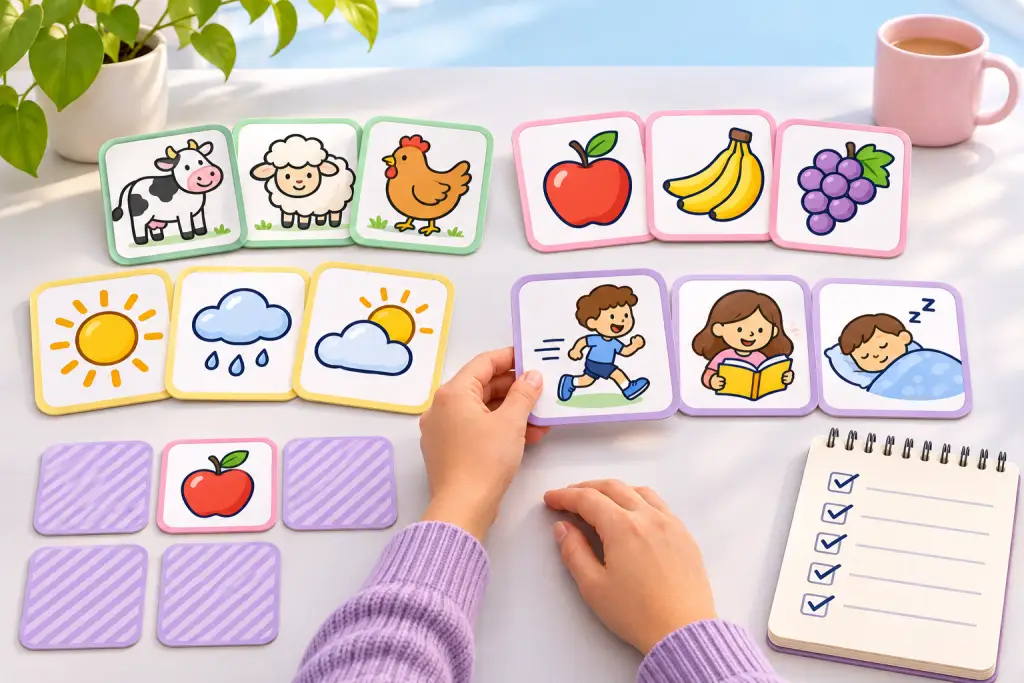
Turn a small set of picture cards into conversation, movement, sorting and storytelling. These seven adult-led games give parents and teachers practical ways to vary a flashcard activity without turning every round into a memory test.
Make a Small Set Work Harder
Flashcards can do more than ask a child to name a picture. A few well-chosen cards can support conversation, sorting, matching and storytelling. The key is to give the cards a clear job and change that job when you want a different kind of activity.
Start with four to six large, clear cards rather than a full stack. Check the pictures and words before the session, choose content familiar to the learner, and use cards and materials appropriate to their age. The adult leads the setup and adapts the activity; finishing quickly or knowing every label is not the aim.
1. Sort, Then Find Another Rule
Place a small mixed group of picture cards face up. Invite the learner to make two groups and tell you why each card belongs. With fruit and animal cards, one possible rule is 'things we can eat' and 'animals'. With a single fruit set, the rule could be a colour you can see in the illustration.
Accept a sensible alternative and ask about it. A learner might group a banana and a cow because both appeared in a story you read. Once the first grouping is clear, ask, 'Can we sort these another way?' Model your own rule if that question is too open. The conversation matters more than producing the grouping you had in mind.
2. Play Find the Clue
Choose four familiar cards and give a clue without saying the answer. For an animal card, try 'I am thinking of an animal with feathers'. For a weather picture, try 'This picture could help us choose a raincoat'. Begin with clues that distinguish one card clearly.
If more than one answer fits, discuss the choices rather than treating the clue as a trick. Then swap roles: the learner gives a clue and you choose a card. For someone not yet ready to describe a picture aloud, offer a choice between two cards or model a short sentence they can complete.
3. Match Pictures and Words
If the set contains separate picture and word cards, start with two pairs. Say a word together, look at the possible pictures and make a match. If the word is printed on the same card as the picture, point to it while naming the picture, or place a separate handwritten adult-prepared label beside it.
Keep the print clear and the examples consistent with the resource. Do not cover a word and insist on independent reading before the learner is ready. You can focus on noticing the first letter, finding two labels that look the same or listening to the spoken word instead. These are different activities, so choose one purpose for the round.
4. Turn Action Cards Into a Guessing Game
Choose a few safe action pictures, such as read, draw or stretch. The adult models one action while another person selects the matching card. Use actions that fit the available space, and offer a seated or pointing version so movement is optional.
After matching, build a short spoken sentence: 'I am reading' or 'The person is drawing'. You can change the person in the sentence without adding more cards. In a group, let learners volunteer to demonstrate rather than putting someone on the spot. Keep turn-taking simple, with one actor and one small set of choices.
5. Tell a Three-Card Story
Pick three picture cards and arrange them from left to right. A cow, a rainy-weather picture and a book might become: 'The cow saw the rain. It went inside. Then someone read a story.' The story can be silly as long as everyone can follow it.
Model a beginning, middle and ending, then let the learner change one event. If three cards are too many, start with one picture and one question: 'What might happen next?' If the activity is comfortable, add a descriptive word or a reason for an action. You do not need to write the story down to have a useful conversation.
6. Try a Small Memory Game
Use matching pairs only where you have the right to print the copies for your licensed setting. Start with two or three pairs, place them face down and take turns turning over two cards. Say what each picture shows before deciding whether the pair matches.
If remembering positions is frustrating, leave the cards face up for the first round. You can also keep one set visible and turn over a card from the other set to find its partner. That changes the task from remembering locations to making a visual match. Avoid increasing the number of pairs just to make the game last longer.
7. Use Cards to Plan or Reflect
Weather cards can support a practical conversation about the day: look outside, compare what you notice with the available pictures and choose a card that fits. If the weather changes, choose another card rather than treating the first choice as a permanent answer.
Emotion pictures can be used to discuss a fictional character in a story: 'Which face might fit this part?' Keep personal sharing voluntary. A facial illustration is a conversation prompt, not a reliable way to diagnose feelings or explain someone's behaviour. Let learners disagree with a label or choose not to make a personal connection.
An Easy Routine for an Adult-Led Session
Choose one of the games, prepare a small set and model a turn. Offer the learner a turn with help if needed. Finish with a quick choice: play another short round, change the rule or put the cards away. You can return to the same pictures on another day with a different purpose.
For a classroom group, consider showing large cards at the front or giving each pair a small, manageable set. Keep the rules visible through demonstration. For home use, an informal conversation at a table may be enough. Neither setting needs a competition or a speed target.
Store and Reuse Your Resources Thoughtfully
Group cards in labelled envelopes or folders by topic and keep the original digital files organised. Check the print quality before preparing a full set. Adults should handle cutting and any laminating equipment, and should choose storage and materials suitable for the learners who will use them.
Our literacy resources and flashcard listings provide possible starting points. Read each description for the included pictures, page format and licence. Choose the game first, then the cards that make that game clear; buying a larger set is not a substitute for a simple plan.